Low-Carb Dieting

When other people think about Middlebury College, I imagine they conjure up scenes of good-looking 20-somethings in matching North Face jackets making their way to 5 a.m. crew practice.

When I think about Middlebury College, I picture a wedge of Laughing Cow cheese.

That’s because the first and only time I set foot in Middlebury, Vermont, I was on a whirlwind Northeast college tour with my mother, and we were both on the South Beach diet. (How, you ask, could someone remember something so specific? Perhaps because the campus’ dining halls served Ben & Jerry’s ice cream, and we weren’t allowed to eat it. Coupled with first loves and N’SYNC lyrics, those are the things one never forgets.)

Anyone who found himself looking for an easy weight-loss fix during the early millennium years undoubtedly tried his hand at a low-carb diet. From Atkins to The Zone to any number of high-protein programs in between, believers were swapping carbohydrates for pork belly faster than they could say coronary artery disease. (Which, to be fair, has nine syllables, so it takes a long time to say.)

I was one of them. Armed with a Dr. Agatston’s first edition of The South Beach Diet, I entered the 14-day kickoff phase, swore off “bad carbs” from orange juice to potatoes and prepared to watch the pounds melt away.

And they did.

As I chowed down on Canadian bacon and reduced-fat cottage cheese, I found to my surprise and delight that the diet’s claims were actually coming true: the scale dropped, my belly flattened and Lloyd Dobler serenaded me with a Peter Gabriel love ballad. It appeared to my 17-year-old self that the South Beach diet was the best thing since sliced bread string-cheese.

But anyone who’s ever found himself forgoing carbohydrates for two straight weeks also knows something else: it’s simply not sustainable. Resisting breakfast cereal for 14 days can give a dieter a sense of perverse satisfaction; resisting breakfast cereal forever can give a dieter a permanent complex. Much like every other low-carb trialist out there, I quickly reverted to my old ways, regained the weight and waited idly by for the next sure-fire diet solution to come my way.

Turns out, that’s not the way it works, and it look the discovery of running and some major caloric accountability to bring myself down to size.

But while I wouldn’t force the full-blown low-carb lifestyle on my worst enemy, even I can admit I gleaned some valuable dietary advice from those arguably misguided pages. Two guiding principles I still choose to follow stand out:

  • Good carbs. Although the South Beach Diet is inherently a low-carb lifestyle, making carbs the indisputable bad guy here, the book argues that not all carbs are as far gone on their journey to the dark side. And I agree. Carbs that include soluble fiber – like fruits and vegetables, legumes and oats – slow digestion and keep you feeling full longer, making them a far superior choice to that glazed donut you were just eyeing. I may no longer read The South Beach Diet book like the bible (or the bible like the bible, for that matter), but I do still opt for whole grain toast over refined Wonder Bread.
  • Good fats. Just as not all carbs are created equal, not all fats deserve a home in the coveted top triangle of your food pyramid (that’s what she said.) Omega 3 fats – found in nuts, flaxseed, tuna and salmon – and Omega 6 fats – found in corn, safflower and sesame oils – can work wonders for a recovering athlete in ways a scoop of chemically-rendered partially hydrogenated oils can’t. I no longer adhere to the diet’s full doctrine, but its plea to choose lean proteins is one I can get behind. (Again, with the she said.)

You may be wondering why I chose to write today about a failed diet fad I attempted in October 2003. The truth is, it was just a long-winded excuse for me to post this delicious low-carb recipe I tried over the weekend:

http://www.recipegirl.com/2012/01/16/cauliflower-crust-hawaiian-pizza/

So there you have it. The big reveal. (Seriously though, make this thing. You’ll be amazed.)

What do you know about nutrition and exercise now that you wish you’d known then? (How about fashion? Would your 2012 self let your 1992 self wear primary colored stir-up leggings? Mine would, because mine’s a jerk.)
How I Became a Runner

This afternoon, I got my first blog post topic request from an old college friend. It read a little something like this:

blog post idea: could you write about how you first started running? like what distance and times were you doing (if you know the times). did you chart your performance or did you just run as much as you could? did you do anything other than running, like complementary weight training (also, do you do that now?)? I ask because you are my hero and I want to be you and I will probably buy you a dozen puppies before our long run this weekend.

(That last sentence might not have been part of the original text. But I can’t be sure.)

OK, anonymous blog fan whose twitter handle is @adamkommel. I’ll tell you about my formative first days as a runner. First, let’s set the stage. I know this is going to be a hard time period and backdrop to visualize, but tap into your deepest creative stores and try to imagine:

The year was 2011 and the city was New York.

After a blissfully slothful 2010, I had entered the New Year with a goal of getting my butt in gear (I believe that’s a scientific term). I immediately began tracking calories and upping my gym frequency, but since I’d made similar changes in the past with little success, I knew I needed something more.

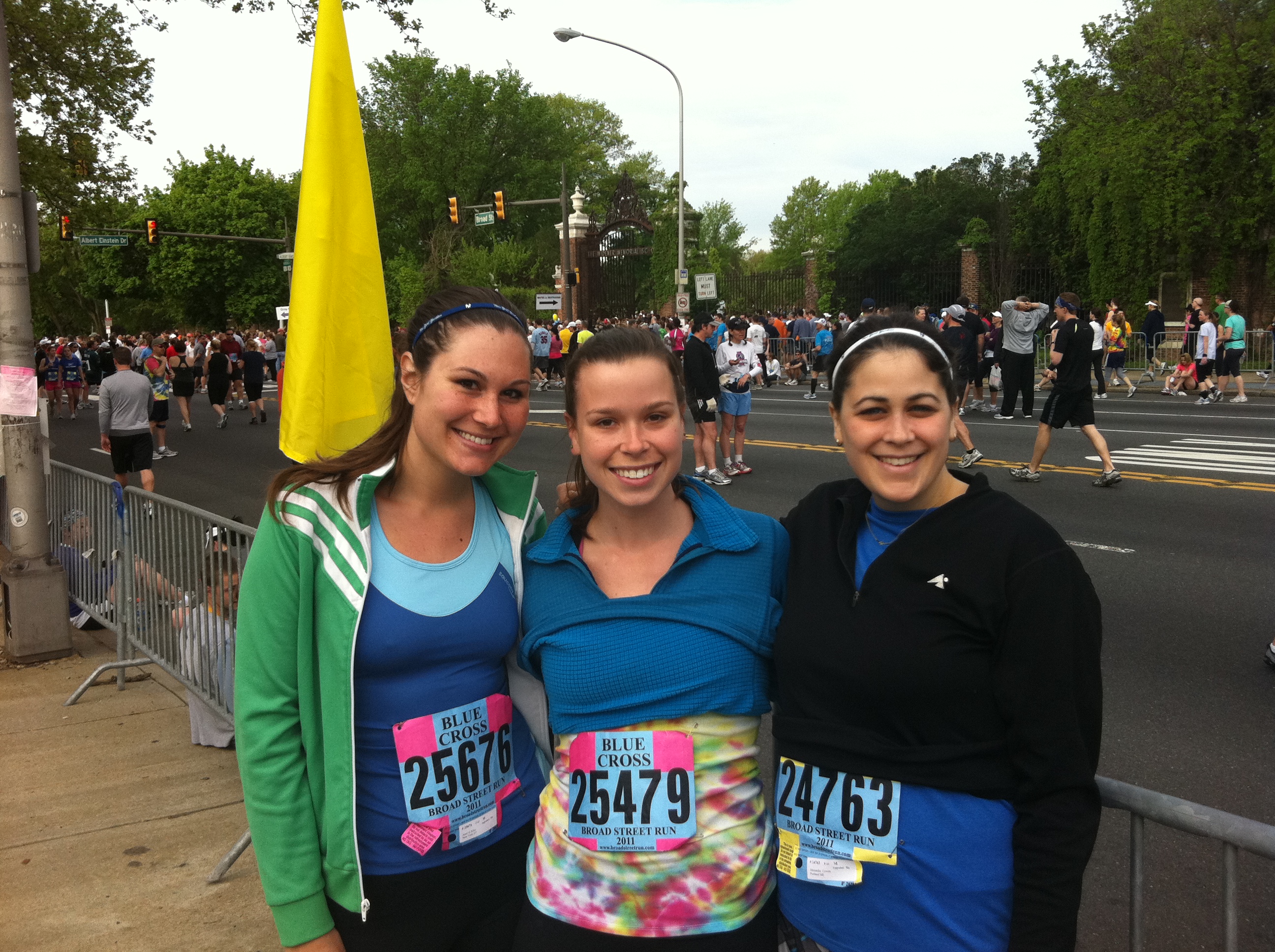
The answer came on Jan. 4, when a favorite friend e-mailed to invite me to register for a 10-miler in Philadelphia later that spring. The offer sounded appealing enough: It is the largest 10-mile race in the country with 30,000 people, and is COMPLETELY flat and without any turns and maybe even a little downhill (only slightly).  P.S. If you join me, I will buy you a dozen puppies, per your usual terms.

Hoping the entry fee would light a fire under my lackluster exercise routine, I quickly submitted the registration form. Of course, typing in the credit card information was the easy part; now I had to get to work. A Type A personality with an affinity for schedules, I scoured the Interwebs for a training plan that someone of my athletic prowess would be able to complete. I ultimately opted for marathon guru Hal Hidgon’s plans, since they were 1. Seemingly achievable and 2. Free.

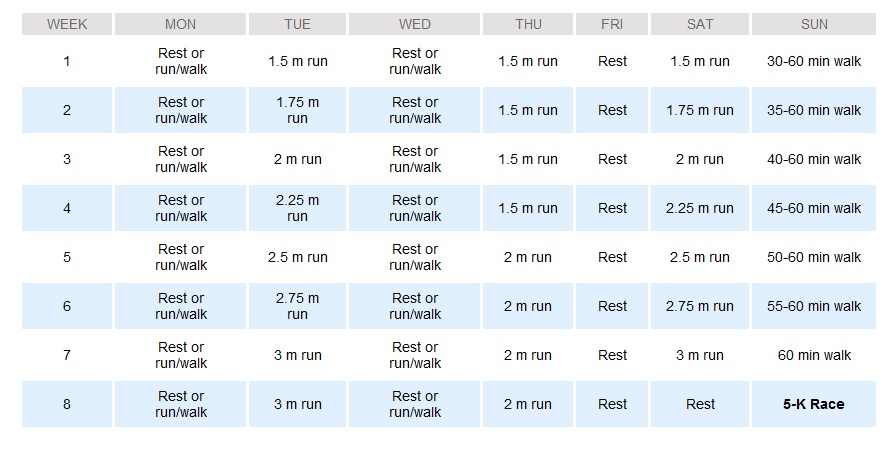
I had nearly four months between registration and race day, so I had enough time to start at Square One and build a fitness base. I began with Hal’s novice 5K plan, which had me logging accessible distances like 1.5 miles and let me be hungover on Sundays:

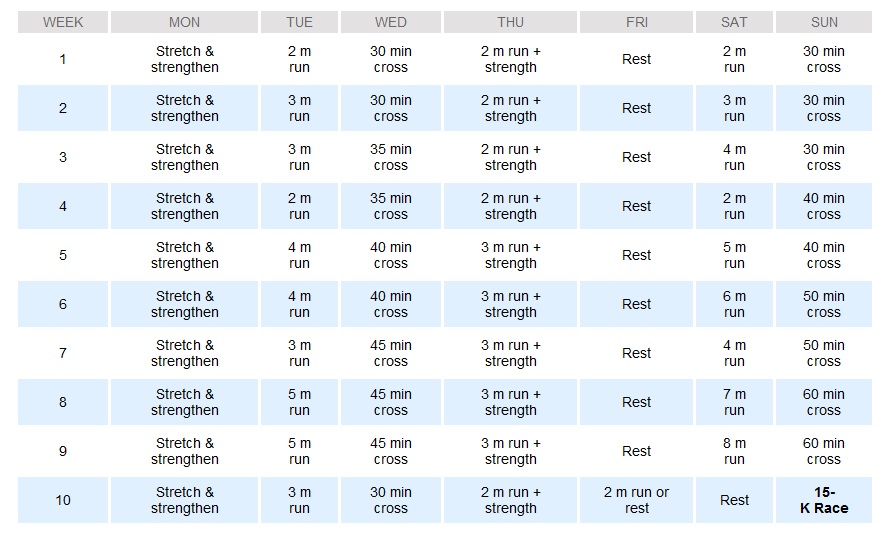
I didn’t chart my performance or measure my pace – I just put one foot in front of the other and ran. By the end of the training cycle, I had built enough of a base to move onto Hal’s novice 15K plan:

This 10-week program brought me up to 8 miles and powered me through the Broad Street Run. Never having timed myself during training, I had simply assumed my pace was a 12-minute mile, like my record-setting high school gym class speed. So you can imagine my surprise – and delight –  when I crossed the finish line at 1:33.23 after sustaining an average 9:20.29 pace. As my favorite 1994 fictional film character said, “From that day on, if I was going somewhere, I was running!”

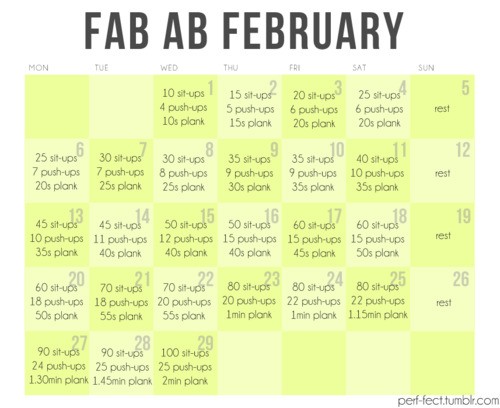
Of course, the downside of loving running is now I’d rather choose to log miles than to do any other form of exercise, including weight training. And you’re right, unnamed avid reader/Adam: strength conditioning is said to be the defining factor when it comes to proper running form, efficient exertion and, ultimately, shaving minutes off my race time. So with that, I give in and will adopt what many other runners have done before me: Fab Ab February.

I may be a week late to the party, but history tells me I’m bound to follow through with a scheduled workout if it’s in calendar form. And if the easy-to-read format isn’t enough to motivate me to keep this up, maybe the March vacation I just booked on a remote Caribbean island will be. Nothing says 100 sit ups like bathing suit season come early.

Now that I’m apparently taking requests, what do YOU want to learn about my running career/food choices/Forrest Gump affinity?

Gridiron Classic Recap or: Why I’m a Terrible New Yorker

Today, Ron Burgundy and I are finding ourselves in a glass case of (mixed) emotions. On one hand, I dominated the NYRR Gridiron Classic (4M) this morning and – despite what I thought would be a detrimentally slow first mile – crossed the finish line at 31:36 and knocked my expected 8:30 race pace out of the park. (Baseball analogies on Super Bowl Sunday? That just came out of left field!)

But while I’m proud beyond belief of my unexpected 7:54 pace, I’m not proud of what I did to achieve it. Is everyone sitting down? Good. To log my new personal best, I had to do the unthinkable. I had to pretend to be a Patriots fan.

Holy Benedict Arnold! – You say. – How did such a thing ever come to pass?

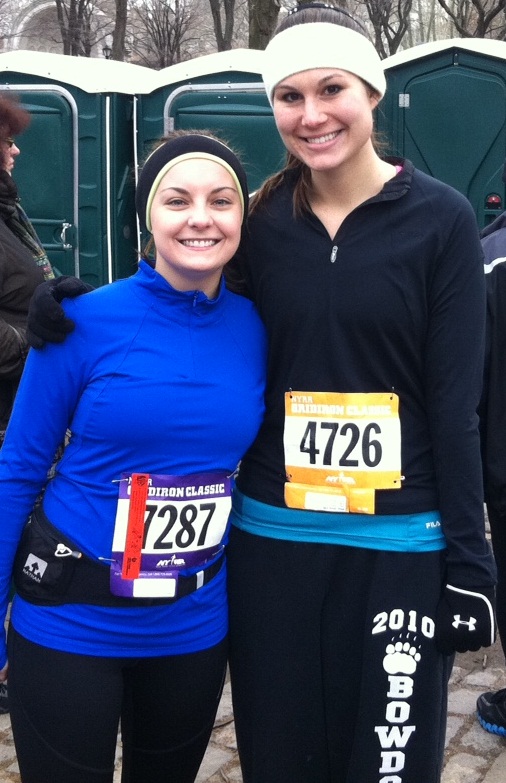
Let’s backtrack to the race’s 9 a.m. kickoff.  (Here I am in the minutes before with my girl Lindsay and a row of porta-pots. They gave us the option of choosing the 1990s laser background, but we went with this one.)

Indisputable fact: this morning’s race was packed. While I loved the rampant crowd camaraderie in the minutes leading up to the starting gun, I quickly found myself cursing the multitude of participants as I tried – and failed – to begin the race at a sub-9:00 pace. I know some degree of foot traffic is to be expected in the first quarter mile of any race, but this morning felt like Times Square gridlock. On New Year’s Eve. In the foyer of Applebee’s.

According to New York Road Runners’ race statistics, 6,058 runners came out to compete this morning, and I estimate about 6,052 of them were running abreast in an impenetrable wall one step ahead of me. Wove as I may, I found myself boxed in from all sides, much like this gratuitous puppy photo. I thought the crowd might start to thin on Cat Hill, or perhaps at the first water station (here’s a course map for you kids following along at home), but as I rounded the 102nd St. Traverse, we were still elbow to elbow to five thousand other elbows. My dreams of a new PR were quickly slipping out of reach.

For all you non-New Yorkers out there, the Gridiron Classic is a football-themed race that encourages participants to wear their team jerseys/heckle each other. As runners make their way across the 102nd St. Traverse before beginning their final descent down the West Side, they’re told to divide themselves by team allegiance and run in the lane designated for their favorite franchise playing in the Big Game. Last year, I imagine Steelers and Packers fans divided themselves pretty equally between the two chutes, making for a steady flow of traffic. This year, Big Blue’s designated lane looked like the 4/5/6 at rush hour, so in the spirit of competition, I squared up my shoulders, lowered my gaze and barreled my way down the desolate Patriots lane.

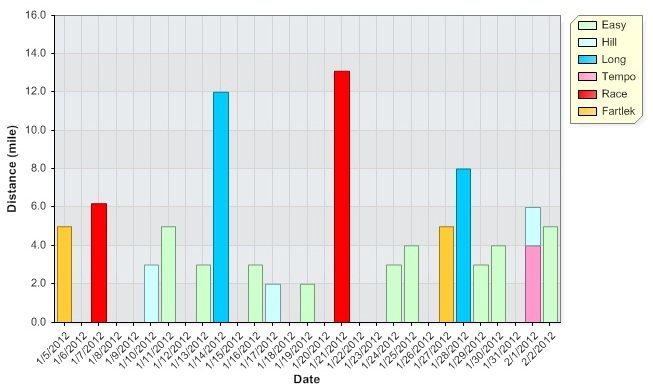
I’m not proud, but those 60 seconds of uncongested roadway gave me the boost I needed to push myself hard to the finish line, allowing me to make up some lost time and secure myself a new personal best. In fact, it was fast enough that – for the very first time  – an online race calculator predicted I’d be able to finish a sub-4:00 marathon with these legs! If you don’t believe me, here’s a screen shot of my very scientific race log:

There you have it, folks. When it came to this morning’s fan breakdown, I took the racing lane less traveled by, and that has made all the difference.

What did you do this weekend that left you feeling proud? How about ashamed? Those usually make for the better stories anyways.

Double or Nothing

Before I begin this blog post, everyone get your heads out of the gutter. We’re all good? Ok.

This week, I did my first two-a-day.

Regrettably, a two-a-day is not the duo of lobsters I’d promised in an earlier post, nor is it an afternoon delight with both my boyfriend and Joseph Gordon-Levitt. (Apparently, I needed you to take your head out of the gutter to make room for mine.)

For all you non-runners out there, a two-a-day is a training technique that has runners running, well, twice a day. (Creative naming was never our strong suit.) Traditionally considered a weapon in the arsenal of elite athletes only, it has quickly made its way into the routines of non-Kenyans worldwide and, on Wednesday, into mine.

Previously of the just-wake-up-and-run camp, I’d never considered legitimate fitness-honing workouts until two people I love bought me dueling subscriptions to Runner’s World and Running Times for Christmas.

(Quick aside: does anyone else get both magazines and, if so, has anyone else noticed the palpable rivalry? Check out this jab about Bill Pierce’s elite training program from a recent Running Times article: “That the program had been featured in Runner’s World had led my hard-core friends to think it wasn’t for serious runners.” Burn!)

Fortunately, I love both magazines equally, so I read both cover to cover each month, and it was in the same January 2012 Running Times that I first read about two-a-days. The article – which I would link to if the magazine put it online, but the modern print editorial model weirdly requires publications to, you know, make money – argues that breaking a day’s miles into two shorter sessions works wonders on the body.

According to author Steve Magness, the benefits are expansive. First, the obvious: “By running shorter twice, you don’t beat your body up as much as on a longer single run. Then, the physical: “You’re now running in a pre-fatigued state. Doing so allows you to access different muscle fibers that you might not normally train, or to push slightly more into the depths of glycogen depletion that would be normal.”

There’s even something for the Californian governors out there: “You get an increase in blood flow twice to help with recovery, and perhaps more importantly an increase in hormones, such as human growth hormone.” That hormonal infusion is key to getting you recovered for the next day’s training session, Magness says. Or in other words, you’ll be back.

Professional runners may break their days down into two double-digit mile sessions, but I started easy: two miles of hill repeats in the morning, followed by a four-mile tempo run at night. I’m not sure if it was the pre-fatigued muscles or the fear that I’d be pancaked by the speeding traffic they apparently let into the park at night, but my four-mile evening run flew by. I don’t own a Garmin GPS watch (hello, generous benefactors!), but it felt like I was cruising at around an 8:35 pace, which is fine in my book.

The two-a-day felt great, but more importantly, it looks great on my training log, and isn’t that what really matters here?

Speaking of doubles, my 85-year-old New England grandmother and I bet $5 on the recent Ravens-Patriots game (little did I know, she had already paid off Billy Cundiff.) Too stubborn to mail her her winnings, I’ve opted to go double-or-nothing for Sunday’s Pats game vs. my adopted New York team. Let’s go Big Blue: help me extort money from a sweet old lady!  (Gram, I know you read this, and you’re going down.)

What workout/gambling plans are on your weekend agenda?

New York City Weight Loss

Eating healthy is hard. It’s harder when you’re not feeling well. It’s harder still when it’s New York Restaurant Week, you have multiple reservations and you intend to eat a steak at every single one. Welcome to my week.

This blog is about my running goals for 2012, not my weight-loss history of 2011. But as I prepare to tackle the University Club’s seafood buffet tomorrow night (spoiler alert: my plate will include two lobsters), I think it’s time I revisited the strategies I employed last year to help me drop 30+ pounds and get me where I am today.

Many of you will remember me at my heaviest:

Despite belonging to a gym – where my workouts consisted entirely of twice-weekly sessions on the elliptical timed perfectly to coincide with Chopped reruns – my affinity for craft (read: high calorie) beers and craft (just kidding) pizza had me consistently taking in more calories than I was exerting. I was well aware 3,500 extra calories equaled one additional pound of body fat, but I wasn’t aware I could do anything about it. Wait, an asteroid isn’t going to hit Manhattan if I don’t eat this entire plate of buffalo wings?

When I made the commitment to myself last New Year’s Day to cut the BS and actually do something about my weight, I was shocked to learn that sustainable weight-loss was possible. Don’t get me wrong – I’m not using “possible” and “easy” as synonyms here, as anyone who may have witnessed me cry over a beet salad (you know who you are) could attest to – but it was finally attainable.

I always hear people say that what works for one person when it comes to weight loss won’t necessarily work for someone else, but I beg to differ. The basic concept – eating fewer calories and burning more – is a hard and fast rule, no matter who you are. The specific tools you employ to motivate you to follow that rule may vary by individual, but the underlying principle holds universally true. Believe me. It’s math.

Your specific tools may be different, but here’s what worked for me:

  • Documentation. A lifelong grazer, I never imagined my occasional nibbles were costing me a single-digit dress size. Although I consistently ordered salads for lunch, I was never one to pass up a couple pretzels from a communal bag or a taste of birthday cake in the conference room. Most of those bites were just that – bite-sized – so I never heeded them much thought. When I began my weight-loss expedition in 2011, I downloaded a calorie counter app and proceeded to document every bite that made it through these lips, and – my god – my snacking added up fast, especially when I only had 1490 calories in my arsenal a day. Knowing I’d have to log that single tortilla chip – and that it would set me back 25 calories to boot – was enough of a deterrent to see me walk away from the bag. Many health sites will encourage keeping a food diary for a week to analyze your problem areas, but I kept mine for the better part of a year, and it paid off.
  • Preparation. The Type As along us have a leg up on this one, but it’s an applicable technique for anyone trying to shed weight. The idea is simple: know what you’re going to eat 12 hours before you sit down to eat it. For example, if I knew I were going to a restaurant tomorrow, I’d hit up menupages tonight, select a healthy entrée to order and then write it in my calorie counter a whole day in advance. Sure, it took the spontaneity out of dining out, but it also took the impromptu bacon cheeseburgers out of my stomach, so I’d say it was a worthwhile trade-off.
  • Activity. For me, it was running.  For you, it might be competitive flash dance mobbing. Find what you love, do it and make sure to push yourself hard enough that you sweat a little more than you like to. (For more information on running, see: blog, this one.)

These tools plus a very patient boyfriendgot me from here:

To Here:

But wait!  you say – how can you be planning to eat multiple steaks this week and still call yourself a healthy eater?

As (I would have said Winston Churchill, but google says Petronius) once said: Moderation in all things, including moderation.

That, and always eat two lobsters at the seafood buffet.

Running Alone

I ran nearly 1,000 miles last year, and if my memory serves me, all but 23 of them were logged as a party of one. There’s something wondrously unrestricting about running solo: I determine my wake-up time, I determine my route, I determine my pace and I determine which bagel shop to use as the finish line (H & H Midtown Bagels East, obviously.) Even my races – with the exception of a turkey trot that proved my brother knows very little about Native American fashion and/or wicking gear – have been solitary exercises, giving me the time to clear my head, listen to my body’s needs and maintain an inner monologue that mostly involves complex plans to kidnap that Bernese mountain dog that jogs on the Bridal Path.

But while I’ve largely relished my unaccompanied workouts these past 13 months, if I’m going to train for a marathon this summer, I’m going to need some legitimate human interaction.

I’m targeting a 3:59:59 marathon time, and the appropriately named 4 Months to a 4-Hour Marathon book tells me I can reach that goal by running up to four times a week, culminating with a 23-miler in Week 14. I run 9 minute miles; do the math. Ok, fine, I’ll do it for you – we’re talking about 3 hours and 45 minutes during my longest long run – and that’s only if I’m able to maintain an unlikely 9:00 pace throughout.

3:45 is a lot of time to spend alone in your own head.  Remember how ungodly long Titanic was? (3:14, if you’re wondering.  Right, Dad?) That means I could watch the entire Leo/Kate saga unfold, and then go back and re-watch the naked scene – twice – and still be running. Common sense tells me that’s too long to run by myself on a nearly weekly basis. (Common sense should have also told them that icebergs are probably best to avoid on a maiden voyage, but I guess hindsight is 20/20.)

That means, folks, I’m in the market for a running partner. Not for every run, mind you – I still love my solo time – but a friendly face or two to join me for a couple of miles each Saturday once I start bona fide training later this year would be a welcome addition. I tested out the group running thing this morning with one of my oldest friends and her man, and let me tell you: 8 miles simply flew by.

Don’t let the solitary smile fool you:

I’m in the market for a partner.

I enjoy candle-lit dinners, a glass of red wine and long walks runs on the beach Central Park loop. Bonus points if you own that Bernese mountain dog I was just devising a complex plan to steal admiring. Who’s down?

Race Plans for the New Year

At noon today, my mother and I took a two-minute break from our respective workdays to simultaneously register for the Irish Sprint 10K in Quantico in March. 

How cute, you may be thinking. A mother-daughter jaunt in the spring Virginia air. It’s true that my mother and I are, in fact, an adorable running pair. And it’s equally true that this 10K race will cover less than half the mileage I logged during Saturday’s half marathon alone. But what’s not true is the notion that signing up online today was a minor event in this runner’s life. Not even remotely.

Because if you read the fine print:

As a just reward for finishing the 10K distance, all runners crossing the Irish Sprint finish line will receive a guaranteed entry into the certain-to-be-sold-out 2012 MCM.

That’s right, folks. By registering today for an adorable 6.2 mile race, I have for all intents and purposes committed to running the Marine Corps Marathon on October 28.

I’m not going to lie. I’m kind of excited. I’m also anxious, proud and downright terrified.  But more importantly:

I’m in.

Who’s with me?

Snow and the Manhattan Half Marathon

When some would-be competitors woke up this morning to discover the New York Road Runners were nixing the timing mats at the Manhattan Half in the face of heavy snowfall and rebranding the race an unscored [too long to actually be fun] “fun run” instead, they understandably let their racing tights off the hook and enjoyed a surprise Saturday morning of sleep.

Tempted to do the same but determined not to let my carb loading go to waste/my waist, I resolved to run the untimed course anyways, so I layered up, hailed a cab and made my way to the starting line.

I wasn’t alone.

I’m not great at estimating crowd size, but somewhere between 12 and 12,000 other city runners manned up as well, and while the wait for the starting gun was downright agonizing, something about hopping around in Spandex in the middle of a Nor’easter with an undeterminable number of equally underdressed strangers makes one feel – how do you say? – supremely badass.

I knew going into this morning’s race I wasn’t going to be breaking my 1:59.34 PR logged at the Baltimore Half because – despite having spent four years of my pre-adult life on the Maine coast – I’m about as graceful in the snow as a penguin. (We’re talking slow, plodding penguins like this one, not the speed-demon penguins from this throwback retro toy that I always coveted.)

So instead, I opted to use the lack of recorded race times as a chance to try out some new things this morning, from shooting down a PowerBar gel at Mile 9 (meh) to stopping to pee mid-course (amazing). Were it a timed race, I would never have risked trying something untested, but today’s non-competitive classification took the pressure off. (It also took a toenail off, but I’m going to try to keep the gross-factor in this post to a minimum.)

Am I disappointed not get the chance to set a new record for myself this morning? Maybe a little. But my non-broken ankles are thanking me for taking it easy in the snow, much like my non-frozen boyfriend should be thanking me for letting him skip out on spectating today. I think chocolates are in order (ankles, I’m talking to you.)

How did your weekend workout plans weather the storm?

Let There Be Carbs

I’m 48 hours out from the Manhattan Half Marathon, and contemporary science and/or this Runner’s World article say I should be upping my carbohydrate consumption considerably to replenish my glycogen stores. Gone are the days when a simple spaghetti dinner constituted proper pre-race preparation. Instead, modern research now suggests runners should start carb loading two or three days before their half or full marathons, eating as many as four grams of carbs for every pound of body weight – or about 2,400 calories of carbs a day for a 150 pound individual.  (Thanks, Runner’s World, for doing that math for me in your article. I’m totally not going to fact check it, so here’s hoping your editors are good with a calculator.)

A daily intake of 2,400 calories of carbohydrates may sound scone-full and delicious, but it’s also significantly harder than you’d think. The above mentioned article says a full 85- to 95-percent of my calories should be coming from carbs in these crucial pre-race days. I don’t know if you know much about percentages, but 95 percent is a huge share. (Fun fact: It is also the statistical likelihood I’d steal a polar bear if left unsupervised in the Bronx Zoo overnight.)

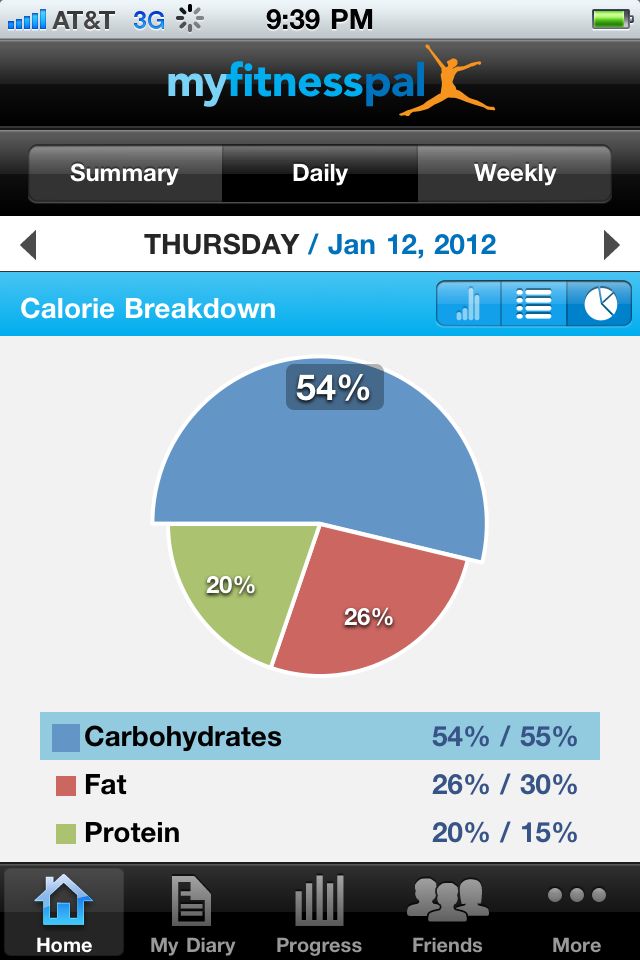
To test just how difficult it would be, I dusted off my knowledge of the scientific method last week and conducted a little experiment: I recorded an entire day’s worth of dietary decisions on an iPhone app to see just how close my normal eating patterns got me to the 85+ percentage point threshold.

Behold failure.

Although I actually went out of my way to up my daily carb consumption – trading my usual greek yogurt for Cheerios at breakfast, ordering a sweet potato with lunch, downing a wheat beer at happy hour (all in the name of science) – I still only achieved a subpar 54 percent. It leaves me wondering: save for shot-gunning a bag of all-purpose flour for dinner tonight, how the hell am I going to reach that range over the next two days?

(It also left me wondering why we don’t use more pie charts in daily adult life. Pie charts are arguably the best form of chart out there, because–honestly–aren’t most things shaped like pies superior? For example: pies. See also: pizza pies. And the number 3.14.)

What’s your best pre-race eating advice? And how did athletes prepare for long runs during the Atkins craze? Bacon-loading? Mmm.

Home Cooked Meals

After a weekend of football-fueled dietary indulgence – including peanut butter flavored chicken wings because apparently I have the nondiscriminatory palate of a Labrador – I woke up from my slothful Sunday afternoon nap ready for a detox. Don’t get me wrong: nothing refuels after a long run like a 100-ounce beer tube from 123-Burger-Shot-Beer (a Danny Meyer establishment, no doubt.) But man cannot live by bar food alone, so once my boy Ed Reed was done clinching Baltimore’s spot in next Sunday’s title game, I put down my waffle fries and vowed to seek out some sustenance.

In a city that delivers 24/7 from an iPhone app that doesn’t demand human interaction, it’s tempting to order in every single meal. But in the spirit of both waist- and wallet-slimming initiatives, I took a page from a more established fitness blogger and on Sunday night cooked my own dinner instead. (That shouldn’t be such a novel concept for the Food Network’s No. 1 fan, but life and/or the pizza place between the 4/5/6 and my apartment always seem to get in the way.)

Fortunately, once I got going on my make-it-myself kick, I couldn’t stop. I whipped up a healthy-ish chicken pot pie for dinner to a chorus of oohs and ahhs from the boyfriend and woke up feeling so much lighter than the morning before that I opted to keep it going and traded my delivery bagel for some home-scrambled eggs. After my three-mile recovery run that morning, I even threw back a green monster for good measure, because anything this ugly in a cup has got to be good for you. (Fortunately, non-ugly things can also come in cups. Case in point.)

(Note: The second half of this post is being written a solid 25 minutes after the first half, because that’s how long it took to pull myself away from googling puppy-in-cup photos. I didn’t know that was a thing, but I’m glad to learn it is.)

Now that my eating habits are once again on track – at least until Ray Lewis works his (allegedly) homicidal magic again next weekend – I can start preparing myself for Friday’s pre-race carb loading session. Bagel-chip lasagna, here I come.

How do you get back on track after a meal – or three – of indulgent eating? And can I justify starting my carb loading on Tuesday? This whole wheat muffin says yes.